

Geneva City – Responsible Citizenship
Raising employees' awareness of their rights and duties with an innovative e-Learning module


Identified needs :
Inform employees and managers : Clarify the rights and duties of each employee.
Understanding Legal Aspects : Clarify the legal aspects of rights and duties in the workplace.
Daily Application : Demonstrate how these concepts translate into daily work practices.
Empowerment : Involve and empower employees and managers in their obligations.
Solutions provided :
20-minute e-Learning module : Consisting of two distinct courses for Employees and Executives, with a common core of knowledge.
Divided courses : Each course is structured into 3 chapters, with intermediate quizzes to check understanding.
Original pedagogical approach : Use of a “trainer's guide” in the form of a virtual avatar to guide learners.
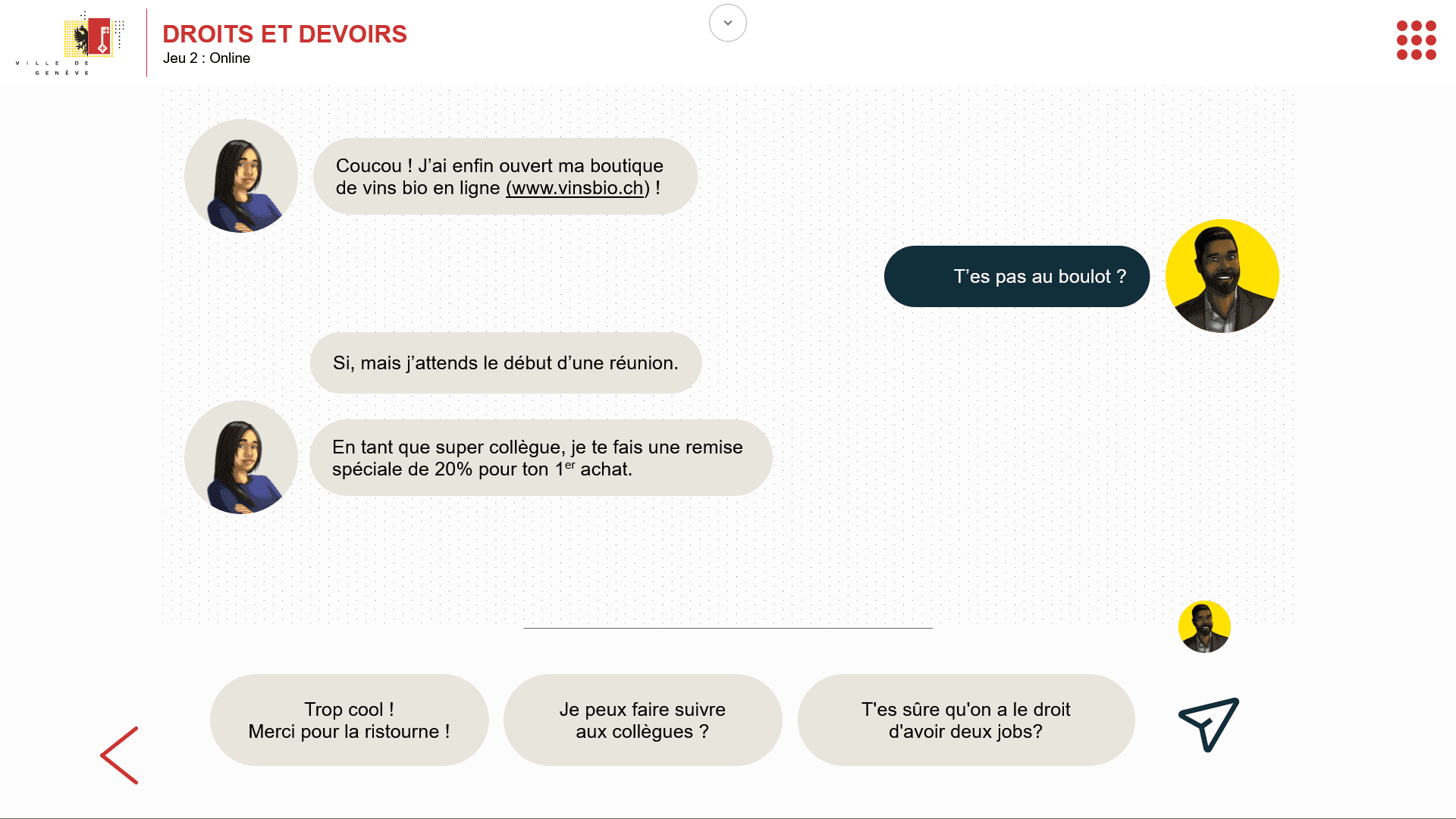
Decision games : Integration of decision games to energize learning and make training interactive.
Benefits and Expected Results :
Adapted training : Separate courses to meet the specific needs of employees and managers.
Simplified content : Simplified legal presentation for better understanding.
Increased commitment : A fun, attractive approach that encourages learner involvement.
Reinforced support : Enhanced support thanks to the virtual avatar, offering personalized assistance throughout the course.
The learning programme has been developed to make legal concepts more accessible by translating regulations into practical situations that employees and managers may encounter in their everyday professional activities. Rather than presenting legislation in a purely theoretical way, the training illustrates how individual rights, responsibilities and organisational rules apply in concrete workplace contexts, making the content easier to understand and remember.
Creating separate learning paths for employees and managers ensures that each audience receives information adapted to its specific responsibilities. While both groups share a common understanding of the organisation's legal framework, dedicated modules address the particular obligations, decision-making responsibilities and managerial practices expected from supervisors. This differentiated approach promotes greater consistency while ensuring that the content remains relevant for every learner.
The integration of decision games encourages active participation by placing learners in realistic situations where they must analyse information, evaluate possible actions and make informed decisions. Immediate feedback helps participants understand the consequences of their choices and reinforces the practical application of legal principles in their day-to-day work. This experiential learning approach improves engagement while facilitating long-term knowledge retention.
The virtual avatar plays an important role in guiding learners throughout the programme by providing explanations, contextual information and educational support at each stage of the course. This interactive guidance contributes to a more intuitive learning experience and helps learners progress confidently through topics that are often perceived as complex or highly technical.
From an organisational perspective, delivering this training digitally ensures that all employees and managers receive consistent information regardless of their department or location. Standardising knowledge across the organisation contributes to greater compliance with internal policies, strengthens transparency and promotes a shared understanding of professional responsibilities.
Finally, learning analytics enable HR teams to monitor participation, completion rates and assessment results while identifying areas requiring additional support. By combining interactive learning, practical decision-making exercises and learner guidance, the programme helps the City of Geneva strengthen legal awareness, encourage responsible behaviours and foster a culture of accountability throughout the organisation.