

SNCF - Mobile Learning for Employees
Enhancing Customer Experience through a Mobile Learning Application
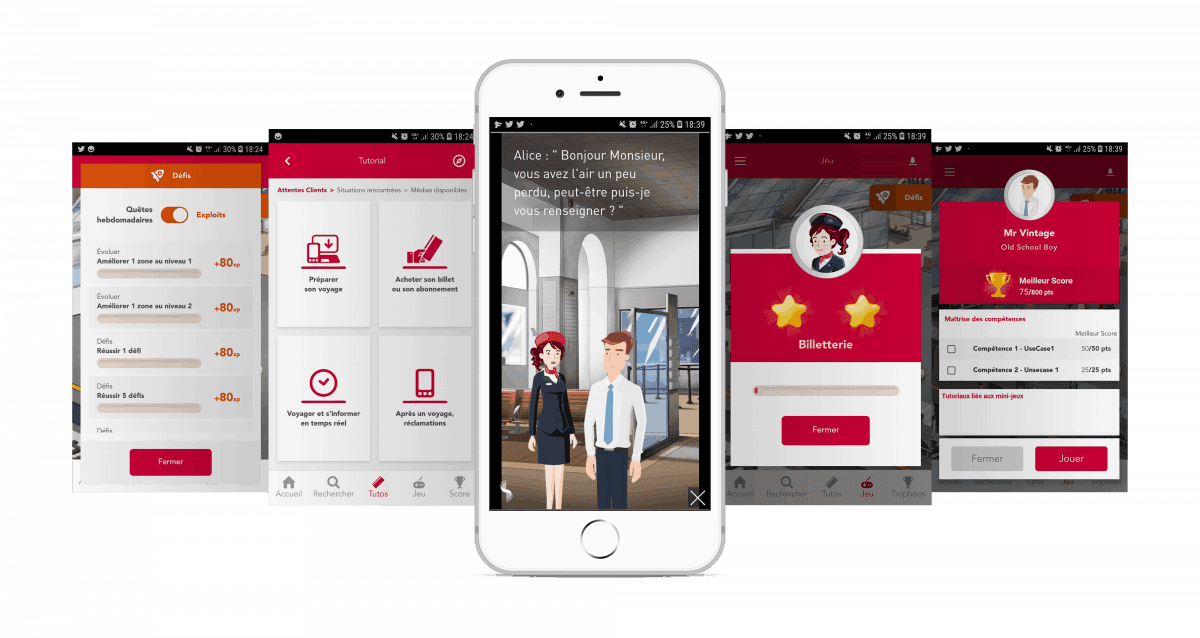
Identified Needs :
Regional Competition : Respond to the opening of regional lines to competition by improving customer service quality and reducing costs.
Mastery of Digital Applications : Train agents to effectively use the digital applications available for customers.
Customer Autonomy : Help customers become autonomous, regardless of their skill levels with digital tools.
Proposed Solutions :
Awareness Campaign : Launch of a communication campaign with a teaser to introduce employees to the new approach.
Virtual Reality Serious Game : Development of a Mobile Learning application in Virtual Reality, providing immersive and flexible training.
Training Content :
Guided Introduction Mission : Initial guidance to familiarize users with the application.
Narrative Missions (Storytelling) : Immersive scenarios to contextualize learning.
Immersive Activities : Various types of interactive activities to engage users.
Expected Benefits and Results :
Immersive Experience : Use of Virtual Reality for enhanced immersion, facilitating learning in real contexts.
Accelerated Awareness : Rapid awareness of employees through interactive and immersive methods.
Interactivity : Increased engagement through interactive activities, promoting adherence, learning, and retention.
Accessibility : Training easily accessible via a mobile application, allowing for flexible learning.
The training programme was designed to support frontline employees throughout the digital transformation of customer services by combining immersive technologies with practical learning experiences. Rather than focusing solely on theoretical instruction, the solution places learners in realistic situations where they can discover, practise and confidently use the digital applications available to passengers.
The Virtual Reality environment recreates everyday operational scenarios encountered in railway stations, enabling agents to interact with customers while using digital tools in a safe and engaging setting. By practising in a risk-free environment, learners can build confidence, develop the right reflexes and improve their ability to assist passengers with varying levels of digital literacy.
Story-driven missions provide meaningful context for each learning activity by reproducing common customer interactions and operational challenges. Employees progressively acquire the skills needed to guide travellers towards digital self-service solutions while maintaining a high standard of customer support and service quality. This experiential approach encourages stronger knowledge retention than traditional classroom-based instruction.
The mobile-first design ensures that training remains accessible at any time, allowing employees to complete learning sessions according to their operational constraints. Short, interactive activities encourage continuous learning while making it easier to update content as new customer applications or digital services are introduced across the railway network.
Beyond individual competency development, the programme contributes to a broader organisational objective by supporting the harmonisation of customer service practices throughout the network. Providing all frontline employees with the same learning experience helps ensure consistent guidance for passengers while facilitating the adoption of new digital services across different regions.
By combining Virtual Reality, mobile learning, storytelling and interactive activities, SNCF benefits from an innovative Digital Learning solution that accelerates the adoption of digital tools, strengthens employee engagement and supports the delivery of a more efficient, customer-centric service experience.
Explore our other product training projects: practical examples designed to strengthen product knowledge, accelerate onboarding, and improve learning effectiveness.
SPIT L'Occitane Horlogerie de luxe Le Marquier Danone Baxter